
(IJCRSEE) International Journal of Cognitive Research in Science, Engineering and Education
Vol. 2, No.2, 2014.
THE RELATIONS BETWEEN MORPHOLOGICAL SPACE AND THE ATHLETES’ JUMPING AND THROWING EVENTS RESULT
Dr. Igor Stanojević, College of professionals studies educators, Aleksinac, Serbia
E-mail: stanojevic3@gmail.com
Received: November, 16.2014.
Accepted: December, 15.2014.
Original Research
UDK 796.42.012.1/.2
Abstract. The sample included 200 primary school students in the region of Prokuplje, male, aged 13 and 14 years, who, in addition to regular physical education classes, were included in the sports clubs training activities. The variables sample included 13 anthropometric measures as a set of predictors and four specific-motor tests of jumping (high jump and long jump) and throwing events (shot put and javelin), as well as a set of criteria. The aim of this research was to examine the relation of morphological characteristics with the jumping and throwing events results, with elementary school students as athletes. Determining the relations and influence between the morphological characteristics and the specific motor skills was obtained by applying the canonical-correlation and regression analysis. The research of canonical correlation analysis results showed that there are statistically significant interlinks between canonical factors of morphological dimension Can. 0.81% (p = .000) and the results of examinee’s specific-motor skills in a long running jump, running high jump, shot put and javelin. Regression analysis results show that the morphological dimensions have an important prediction of the results of examinee’s specific-motor skills.
Keywords: Morphological characteristics, Specific-motor skills, Athletes.
1. INTRODUCTION
Athletes’ development of anthropological characteristics and the increase of motor skills level should start with determining the current state of abilities and characteristics in order to properly execute the planning, programming, work implementation and analysis of the effects of the training process. Application of transformation exercise processes is possible only if we know the level of anthropological characteristics and motor skills involved in the success of a motor activity, and their mutual relations in order to realize which program content, methods, and loads can help to achieve adaptation processes in the most optimal way (Kukolj and associates 2001, Pržulj 2006). The development of skills and characteristics (according to Krsmanovic 2007, Željaskov 2003, Bjekovic 2008) can be achieved most successfully in the so-called “Sensible stages,” which are periods of ontogenesis, when, based on natural laws, the most significant rate of development of certain skills and characteristics is achieved, the adaptive capabilities in relation to exogenous factors are increased and favorable conditions for the acquisition of certain motor skills are established. Successful selection of future athletes, athletic performance improvement of individuals and sports teams can be achieved only through scientific research in the field of sports and sports training. In most countries, whose athletes achieve significant results, the sport science is on the high level. Scientific knowledge obtained during research in the field of sports is applied, primarily in the analysis of sports results and the conditional readiness degree. Based on these data, preparations for future competitions are planned and programmed.
Having in mind that a sports training is complex in its structure because the transformations take place in the space of morphological, functional and motor space that belong to the multi-dimensional dynamical systems, it is necessary to analyze the anthropological characteristics of athletes more thoroughly and accurately. To this end, it is important in order to apply appropriate scientific procedures to determine the structures of dimensions, their relations and development principles, and policies providing direction and control of the work effects. In addition, it is important to establish a reliable measuring instruments for monitoring and measuring the changes of dimensions that are to be achieved by using the resources of physical exercises. Accordingly, the results of this research should show that the dimensions of morphological characteristics contribute to jumper’s efficiency results (high jump, long jump) and throwing events (shot put. Javelin) applied to primary school athletes.
2. METHODS
The aim of this study was to determine the relation of morphological characteristics with the primary school athletes’ jumping and throwing events results. The sample included 200 primary school students in the region of Prokuplje, male, aged 13 and 14 years, who, in addition to regular physical education classes, were incorporated into the sports clubs training activities.
The variables sample included 13 anthropometric measures as a set of predictors:
body height (AVIS), length of legs (ADUN), length of an arm (ADUR), shoulder width (ASRA), width of the pelvis (ASKA), hip width (ASKU), volume of the upper arm (AONL), thigh volume (AONK), the maximum lower leg volume (AOPK), body mass (AMAS),upper arm skin fold (AKNNL), abdominal skin fold (AKNT) and thigh skin fold (AKNNK).
Four specific-motor tests of jumping and throwing events as a set of criteria: running long jump (SKDA), a running high jump (SKVI), shot put (BCKU) and javelin (BKOP).
Determining the relations and influence between the morphological characteristics and the specific motor abilities was achieved by applying the canonical-correlation and regression analysis.
3. RESEARCH
Canonical correlation analysis
Table 1. Canonical correlation analysis of the examinees
The results of canonical correlation analysis show (Table 1) that in the relations between the predictor systems, consisting of anthropometric measures to assess the morphological characteristics and criteria made of the variables for assessment of jumping (a long jump and a running high jump ) and throwing events (shot put and javelin), we got a statistically significant canonical factor (R) witch indicates, with 81%, the size of the correlation coefficient, which is confirmed by the percentage of common variance of the determination coefficient (R2) for both sets of variables with 65%. Given the size of the canonical correlation coefficient and the common variance, it can be concluded that the results of the examinees in the jumping and throwing events will be manifested largely depending on their morphological space. Canonical root was statistically significant at the level of P = .000.
Table 2. Canonical factors of examinees’ anthropometric measures
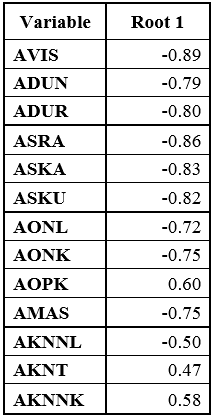
In Table 2, anthropometric measures of skeleton’s longitudinal dimensionality, skeleton’s transversal dimensionality, circular dimensionality and body mass have the most projection to the canonical factor, and therefore condition results at the most in all jumping and throwing events tests. Measures of subcutaneous adipose tissue have somewhat smaller but significant impact on the manifestation of the examinees’ results in jumping and throwing events.
Table 3. Canonical factors of examinees’ criterion
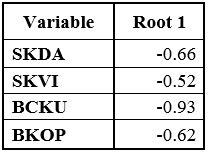
In Table 3, the obtained results indicate the large projection of jumping and throwing events on canonical factor. Canonical factor of specific motor performance in jumping and throwing events is best defined by shot put (BCKU = -0.93) and long jump (SKDA = -0.66) assessing tests. The effectiveness of performing these specific-motor skills obviously strongly is dependent on the longitudinal and transversal dimensionality factor.
Table 4. Cross correlation analysis of anthropometric measures and results in jumping and throwing events

From the cross correlation anthropometric measures matrix and the examinees’ performance results of the specific-motor skills (Table 4), we can see different levels of correlation coefficients. The body height (AVIS), legs length (ADUN) and the width of the pelvis (ASKA) significantly contribute to the success in specific-motor skills.
3.1. Regression analysis
Table 5. Regression analysis of morphological characteristics predictor system running long jump (SKDA)
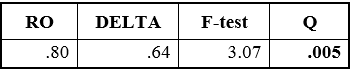
Build on the value of multiple correlation coefficients (RO =. 80), in Table 5, it can be concluded that the morphological characteristics (as predictor system) at the multivariate level, significantly explain (Q =. 005) the results achieved in the long jump (SKDA).
The determination coefficient of criterion variable (DELTA) and the anthropometric measures system has 64% of common relations. The remaining 36% of common variability in explaining the criterion variable are included in the other anthropological space dimensions which were not the subject of research in this study.
Table 6. Regression analysis of predictor anthropometric measures and criteria running long jump (SKDA)

Results of partial regression coefficients (Beta) and its significance Q (Beta) on the univariate level (Table 6), indicate that a statistically significant relations with the criterion variable have predictor anthropometric measures of longitudinal skeleton dimensionality: body height (AVIS), legs length (ADUN) length of the arm (ADUR) and circular dimensionality of the skeleton and body mass: volume of the upper arm (AONL), thigh volume (AONK), the volume of the leg (AOPK) and body mass (AMAS).
Table 7. Regression analysis of predictor system of morphological characteristics and criterions a running high jump (SKVI)

Build on the value of the multiple correlation coefficients (RO =. 79), in Table 7, it can be concluded that the morphological characteristics (as predictor system) at the multivariate level, statistically significantly explain (Q =. 015) the results achieved in the high jump (SKVI).
The determination coefficient of criterion variable (DELTA) and anthropometric measures system has 62% of common relations. The remaining 38% of common variability in explaining the criterion variable are included in the other anthropological space dimensions which were not the subject of research in this study.
Table 8. Regression analysis of predictor anthropometric measures and criteria running high jump (SKVI)

Results of partial regression coefficients (Beta) and its significance Q (Beta) on the univariate level (Table 8), indicate that a statistically significant relations with the criterion variable have predictor measures of longitudinal skeleton dimensionality: body height (AVIS), legs length (ADUN) and length of the arm (ADUR)
Table 9. Regression analysis of predictor system of morphological characteristics and criteria a shot put (BCKU)

Build on the value of the multiple correlation coefficients (RO =. 61), in Table 9, it can be concluded that the morphological characteristics (as predictor system) at the multivariate level, statistically significantly explain (Q =. 022) the results achieved in the shot put (BCKU).
The determination coefficient of criterion variable (DELTA) and anthropometric measures system has 37% of common relations. The remaining 63% of common variability in explaining the criterion variable are included in the other anthropological space dimensions which were not the subject of research in this study.
Table 10. Regression analysis of predictor anthropometric measures and criteria shot put (BCKU)
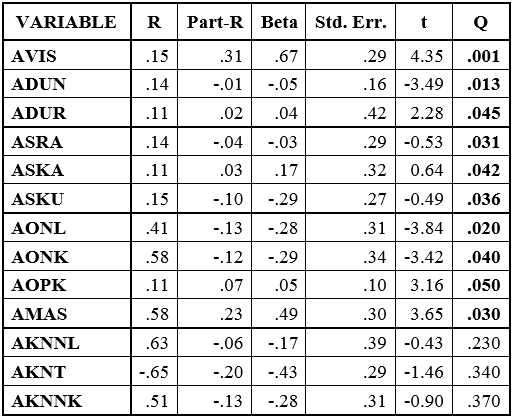
Results of partial regression coefficients (Beta) and its significance Q (Beta) on the univariate level (Table 10), indicate that a statistically significant relations with the criterion variable have predictor variables of longitudinal skeleton dimensionality: body height (AVIS), legs length (ADUN) arms length (ADUR); transversal skeleton dimensionality: shoulder width (ASRA), width of the pelvis (ASKA), hip width (ASKU) and circular skeleton dimensionality and body mass: volume of the upper arm (AONL), thigh volume (AONK), lower leg volume (AOPK), body mass (AMAS).
Table 11. Regression analysis of predictor system of morphological characteristics and criteria javelin (BKOP)

Build on the value of the multiple correlation coefficients (RO =. 90), in Table 11, it can be concluded that the morphological characteristics (as predictor system) at the multivariate level, statistically significantly explain (Q =. 000) the results achieved in the javelin (BKOP).
The determination coefficient of criterion variable (DELTA) and the system of motor variables have 80% of common relations. The remaining 20% of common variability in explaining the criterion variable are included in the other anthropological space dimensions which were not the subject of research in this study.
Table 12. Regression analysis of predictor anthropometric measures and criteria javelin (BKOP)

Results of partial regression coefficients (Beta) and its significance Q (Beta) on the univariate level (Table 12), indicate that a statistically significant relations with the criterion variable have predictor variables of transversal dimensionality: shoulder width (ASRA), width of the pelvis (ASKA) and hip width (ASKU) and circular skeleton dimensionality and body mass: volume of the upper arm (AONL), thigh volume (AONK), lower leg volume (AOPK), body mass (AMAS).
4. CONCLUSION
The research was undertaken with the aim to determine the relations between the morphological space and jumping and throwing events.
Based on the research results, interpretation and discussion we can conclude the following:
1.There is a statistically significant canonical correlation (p = .000) between the anthropometric measures of morphological dimensions and the results of jumping and throwing events.
The results showed that one canonical factor was distinguished which is statistically significant and accounts for this connection between the set of predictors and the set of criterion variables.
1.1.A statistically significant multiple correlations (Q = .005) was determined between the morphological dimensions measures and the running long jump results.
1.2.A statistically significant multiple correlations (Q = .015) was determined between the morphological dimensions and the running high jump results.
1.3.A statistically significant multiple correlation (Q = .022) was determined between the morphological dimensions measures and the shot put results.
1.4.A statistically significant multiple correlations (Q = .000) was determined between the morphological dimensions measures and the javelin results.
Conflict of interests
Authors declare no conflict of interest.
REFERENCES