(IJCRSEE) International Journal of Cognitive Research in Science, Engineering and Education
Vol. 2, No.1, 2014.
CORRELATION BETWEEN THE PROFESSIONAL INTERESTS AND THE GENDER OF THE YOUNG PERSON
Slagjana Angjelkoska, Psychologist, Center for Social Care, Gostivar, Macedonia
E-mail: as.anima@hotmail.com
Dr. Gordana Stankovska, Faculty of Philosophy, Institute for Psychology,
State University in Tetovo, Macedonia
E-mail: g.stankovska@yahoo.com
Received: May, 11. 2014.
Accepted: May, 23.2014.
Original Article
UDK 159.922.72.075(497.7)
Abstract: The concept of the professional orientation means to care and help for the young person in deciding about the professional orientation in which he or she will develop considerably his/her working capabilities while a complete rationalization in the creating and expressing of the personality will be achieved. It is known that while the choice is made, which is important for the whole life there is a many factors that influence the person. Reaching the decision is especially difficult for the eight – graders, because they are in the period of developing in which the exterior factors have a major influence while they are making their decision about their future job (work).
The basic aim of this research was to be seen if the professional orientation of students depends on their gender. The research is performed on samples of 67 students (examinees) from the eighth grade in several primary schools in Gostivar. The basic mean (instrument) that was used in the research was a Test of Professional Interests (TPI). The results of our research have shown that the greater number of the male students’ choice was A category (mechanical work) and G category (administration) while the female students were mostly interested in category I (social-medicinal work) and category H (educational and cultural work). The level of correlation between the gender and the professional interests is a level of significance of 0,01.
The results confirm that professional interests and the selection of the future job (work) of the eight–graders depend on their gender, but also it depends on their personality and the exterior factors.
Keywords: Personality, Development, Professional interests, Gender.
1. INTRODUCTION
The development and the appearance of the professional orientation are closely related to the name of F. Parsons who in 1970 founded the first counseling service for selection of a profession. According to him the right choice of the profession is based on rational execution and coordination of the one’s capabilities and the job’s demands. Parsons considers that the choice of the profession is consisted of three phases:
The view of the professional orientation has changed as the time has changed and they developed under the influence of the development of certain branches of psychology. Based on this development, a conclusion emerges that the basic aim and task of those who deal with professional orientation is to help the young people to be more informed about the possibilities, interests on one hand and objective conditions in the surrounding on the other hand. That is how the person would have an opportunity for free and independent selection of the job (Hart, D., Cropanazo, R., 1997).
Professional orientation is considered as a dynamic psycho-pedagogical discipline. According to Guzina 1980 professional orientation is a complex and systematic activity of offering help to the person in solving problems that refer to the selection of a job and his /her further development. Strong (1981) defines the professional interest as a collection of numerous interests that in any way refer to the professional life of the person.
Many factors have influence on the professional interests, but a special emphasize is put on psycho-social factors such as the social status of the parents, their profession, school, friends, place of living ,means for mass communication and the characteristics of the person, gender and the age. Certain researchers confirm that the gender is a significant variable while selecting the profession. Under the influence of the traditional beliefs in many countries the males (boys) select technical, but the females (girls) choose the humanitarian jobs. According to Guzina 1980 the women choose the traditional women jobs ,personnel in educational and medical institutions (17,4%), teachers (13,4%), workers in medical and social institutions (7,8%), hairdressers (9,5%), tailors (7,8%).
The theories of the selection of profession developed in 1951 and are divided into two groups:
1. The developing theories which apprehend and explain the selection as a process, emphasizing that it is made through the vears and not instantly. Besides that, it is considered that the process of professional selection goes through phases i.e. stages, so there is a tendency of monitoring the job decision and adaptation throughout the years of working. There belong the theoretical concepts of Ginsberg and Super (Hendrix, V., 2009).
2. The different theories start from the idea of individual differences that are present among people and they put the accent that people differ from each other in the sense of their capabilities, interests and characteristics. On the other hand, different jobs have different demands, so the choice of the profession is understood as a process of defining of these factors and the adequacy and capability of the selection are considered as a balance between the person and the profession. Representative theories of this group are the theories of Raw and Holland (Nikoloski, T., 2000).
2. RESEARCHING PROBLEM AND METHOD
The basic idea of this research is to be shown if there is a connection between gender (male/female) of the students and the selection of the future profession with the eighth-graders. During the research we used the Test of Professional Interests (TPI) which is standardized for the Macedonian population. The test consists of different jobs/trades from which we have to examine chooses the one he/she likes the best and it is always in different combination of jobs (fields) It includes the following areas of interests i.e. groups of interests.
A-Mechanical work: construction sites (manual and technical work along with physical work in factories (different trades in workrooms or repair);
B - Precise technical work: covers making models, drawings and products;
C - Technical measuring: covers different laboratorial and field work;
D - Manual work;
E - Agriculture, gardening, forestry’s tock-breeding;
F - Trade - selling, supplying, bank work, insurance, tourism;
G - Administration - managing, accounting work;
H - Educational - cultural work, high school, journalism, music, drama
I - Social and health care.
Each of the above groups of interests covers 18 different fields of different jobs/trades. The trades are grouped so that the examinee selects among 4 jobs and each job/trade is chosen four times.
In research 67 students of eight grades are involved, and 33 of them were males and 34 were females. The basic hypothesis of this research said that there was a connection between the gender of the students and the professional interests in the eight-graders. Megastar correlation was used for statistical processing of the data on the level of significance of 0,01, while the hypothesis is tested with ANOVA - Fisher test.
3. RESULTS AND DISCUSSION
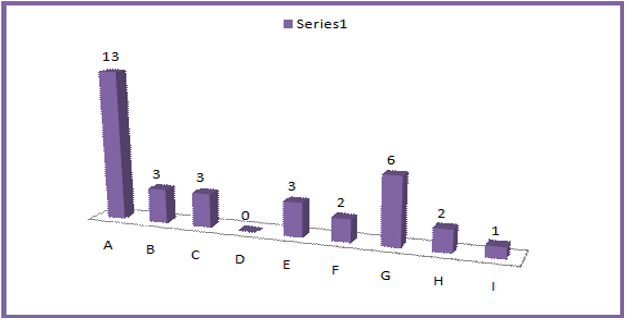
From the analysis of the results from the TPI test referring to the gender in each of the given category we got interesting results. The male students have made the following selection of interests about jobs: category A-13 (39,3%); category B-3 (9,1%); category C-3 (9,1%); category D-0; category E-3 (9,1%); category F-2 (6,1%); category G-6 (18,2%); category H-2 (6,1%); category I-1 (3%). Out of this percentile analysis it can be concluded that the most of the male students made selection of category A (mechanical work) and category G (administration) while for category I (social-health work) only one student was interested and category D (manual work ) is not preferred at all by the students. (Graph 1).
Graph 1. Preferred interests by male students
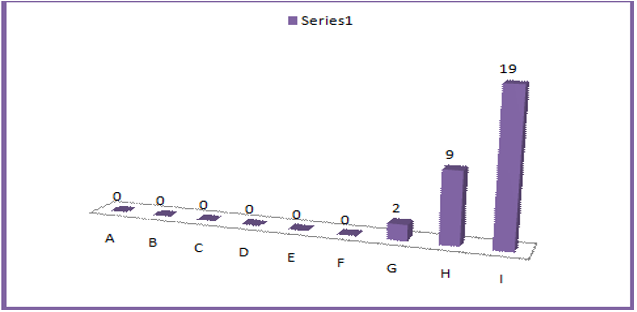
Female students have made the following choice: category A-0; category B-0; category C-0; category D-0; category E-0; category F-0; category G-2 (5,8%); category H-9 (26,5%); category I-19 (55,9%). From this percentile analysis it can be concluded that the female students show greatest interest in Category I (social-health work) and category H (cultural and educational work) and only two students have chosen category G (administration), while the rest of the categories were not selected at all (Graph 2).
Graph 2. Desired interests by female students
While confirming of the connection between the gender as an independent variable in the research and the interests for professions as a dependent variable with Megastar correlation we have result that there is a connection between the gender of the students and the interests about the profession on significance level of 0, 01. In the same time the positive correlation between the gender and I(social work),while there is a negative correlation between the gender and the scale A(manual work) and scale C(technical measuring)., ( Table 1).
Table 1. Matrix of the correlation between the gender and the interests for the profession

While testing the hypothesis by use of Fisher’s test we got that the value (result) of F is 22,19; df is 9, while F coefficient is significant on level p<0,01. From that we concluded that there is a connection between the gender and the interests for work in the eight-graders.
The results we got confirm that there is a difference in the attraction towards certain job in reference with the gender, In fact, those areas that are more attractive for male are less attractive for female students. So 39, 9% of the male students have chosen the factor A i.e. mechanical work which includes manual or mechanical work, physical work in a factory, workroom, the following group of attractive jobs for males is group G with 18,2% which includes administrative work, accounting and other. As the least attractive jobs for males are group D.
Our research results do not concur with the research conducted by T. Tracey in 2006 .Namely in his research conducted on school population he got results which say that the males’ least attractive jobs are from group A, while the female students have shown great interest in group I.
4. CONCLUSIONS
From the research and its statistical processing the following conclusions can be extracted:
There is a connection between the gender and the choice of the profession with the eighth-graders
The most of the male eighth-graders prefer mechanical work.
The most of the female of the eighth-graders prefer social-health work.
The least preferred job in male eighth-graders is manual work.
The least preferred jobs in female eighth-graders are mechanical work, precise technical work, technical measuring, manual work, agriculture, trade.
REFERENCES
Bele-Potočnik, Z (1967). Priručnik za TPI, Psihološki fakultet: Ljubljana.
Guzina, M. (1980). Kadrovska psihologija, Naučna knjiga, Beograd.
Hendrix, V. (2009). Professional interests and Person`s characteristics, Journal of Psychology, 6(8), 155-172
Hart, D., & Cropanazo, R. (1997). Bridging the gap between academics and practice. Industrial-Organizational Psychologist, 35, 29-32.
Jex, M. S. (2000). Organizational psychology: John Wiley and Sons: Canada
Nikoloski, T. (2000). Psihologija na trudot: Skopje
Tracey, T. (2006). The Correlation between gender and professional work: A longitudinal study. Journal of Behavior, 69, 65-72